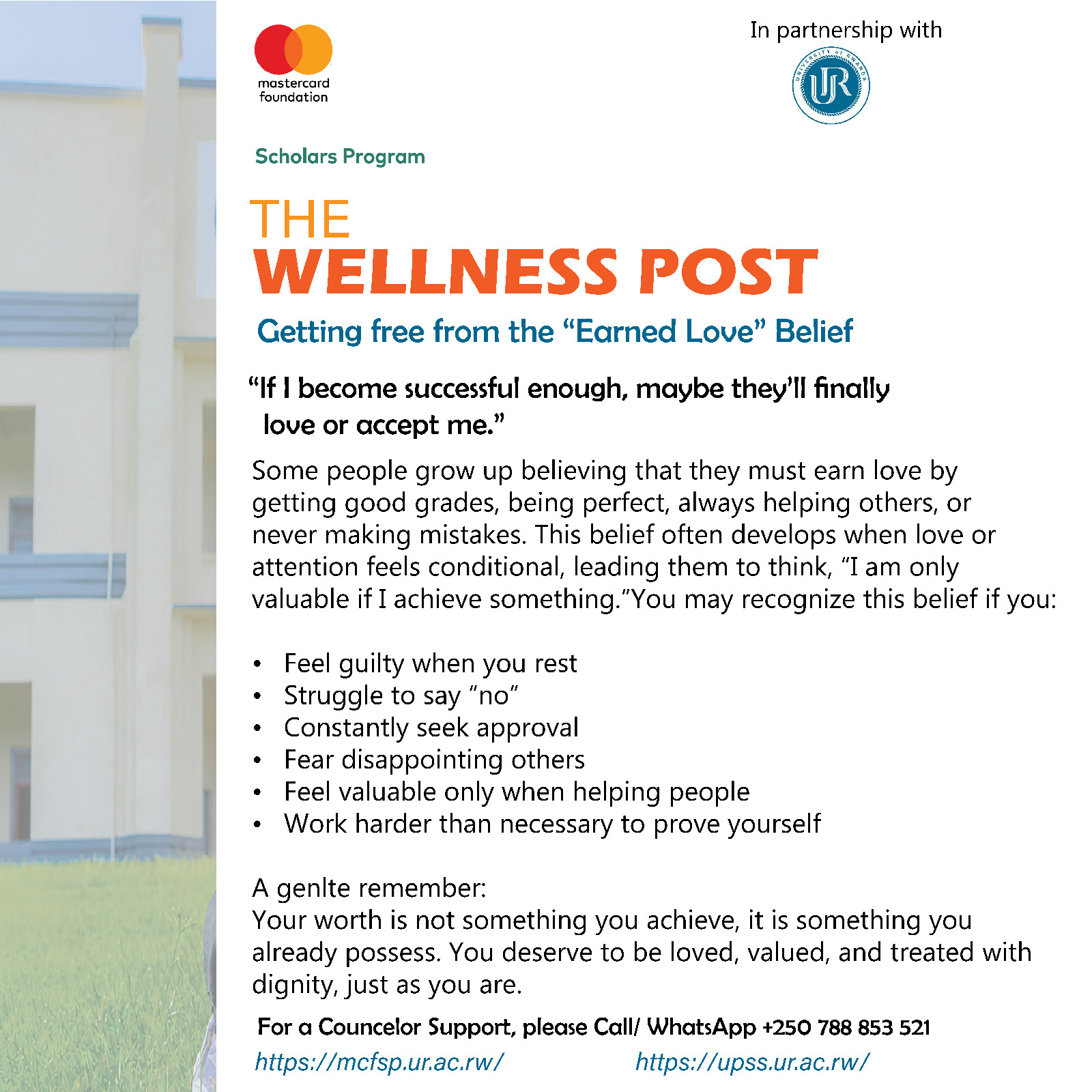
The Wellness Post: Your worth is something you possess, not something you achieve: Getting free from the "Earned Love" Belief
Some young people grow up believing they must earn love by getting good grades, helping everyone, being perfect, or becoming successful. This is a core belief that often develops when someone grows up experiencing love that feels conditional, inconsistent, or emotionally unavailable. It is the conviction that a person's worth depends on what they achieve, provide, or sacrifice.
This belief often begins in childhood, when love or attention seems conditional; for example, when parents praise only achievements, ignore a child's emotions, or show affection only when the child behaves well. Over time, the child may begin to believe, "I am only valuable if I achieve something."
For many young people, this belief quietly shapes their friendships, romantic relationships, family responsibilities, academic performance, and even career choices. People who carry this belief often feel they must continually prove their worth through academic success, financial support, good behavior, obedience, perfection, taking care of others, never making mistakes, and always saying "yes" to the needs and expectations of others.
However, the earned love belief is something we need to free ourselves from in order to build healthier relationships and improve our emotional well-being. The first step toward overcoming it is recognizing its signs.
Some common signs of the "Earned Love" belief include the following:
- Feeling guilty when you rest.
- Struggling to say "no."
- Constantly seeking approval from others.
- Fearing that you will disappoint people.
- Apologizing excessively, even when unnecessary.
- Feeling valuable only when you are helping others.
- Working harder than necessary to prove yourself.
- Rarely asking for help.
- Believing that your needs are a burden to others.
- Feeling uncomfortable when receiving kindness or support.
Why it is important to break free from the "Earned Love" belief
One of the greatest tragedies of the earned love belief is that it convinces people they are never enough, regardless of how much they achieve. It keeps them constantly chasing approval while overlooking a simple truth that has always been there: your worth is not something you earn; it is something you inherently possess.
You do not become more deserving of love because you graduate from university, earn a high salary, support your family financially, or meet everyone else's expectations. These accomplishments may be meaningful and worth celebrating, but they do not determine your value as a person.
Healthy love does not require endless proof of your worth. The people who truly care about you may appreciate your generosity, hard work, and achievements, but these are not the conditions for being loved or accepted.
The healthiest relationships are built on mutual respect, honesty, compassion, trust, and acceptance; not on a lifetime of trying to earn what every human being already deserves: to be loved, valued, respected, and treated with dignity.
Practical steps toward fealing from the "Earned Love" belief
Living with the earned love belief can affect nearly every area of life. Many people appear highly capable and successful on the outside while privately feeling empty, exhausted, and unworthy.
Recognizing that you have these patterns is not something to be ashamed of. Rather, it is an opportunity to understand yourself with compassion. Awareness is the beginning of healing.
Healing starts by questioning this belief and reminding yourself that:
- Your value is not determined by your grades, income, achievements, or productivity.
- Healthy relationships do not require you to constantly prove your worth.
- It is okay to set boundaries and say "no."
- People who genuinely care about you value you for who you are, not just for what you do.
- Talking to a counselor or psychologist can help you understand where these beliefs originated and develop healthier ways of thinking and relating to others.
With Love,
ISHIMWE Christella
Psychosocial Support Officer
Mastercard Foundation Scholars Program
University of Rwanda